The 5 Stories Every Purpose-Led Brand Needs
You’ve Been Told to Tell Your Story. But Which One?
It’s become pretty much textbook branding or marketing: tell your story, start with your why.
Of course you know your story matters. There’s something meaningful in your work, your path, and the people you serve, otherwise you wouldn’t be where you are today.
But when you sit down to actually start writing, the blinking cursor syndrome sets in:
Which story do I tell? My personal story? My mission? A client’s experience?
Do I start from the beginning, or jump to what I do now?
Is my story even interesting enough? Is it really different from everyone else in my field?
If that sounds familiar, I’m here to share some relief: the problem isn’t that you don’t have a story. The problem is that no one has ever told you that your brand actually needs several stories, and that each one has a specific job to do.
Most purpose-led brands don’t need more storytelling. They need the right stories in the right places.
A strong brand narrative isn’t one story repeated everywhere. It’s a collection of stories that work together with each one serving a different purpose, answering a different question, building a different kind of trust.
When these stories are in place, your messaging becomes clearer. Your audience feels more certain. And you stop having to reinvent what you say every time you sit down to write (definitely stressful!).
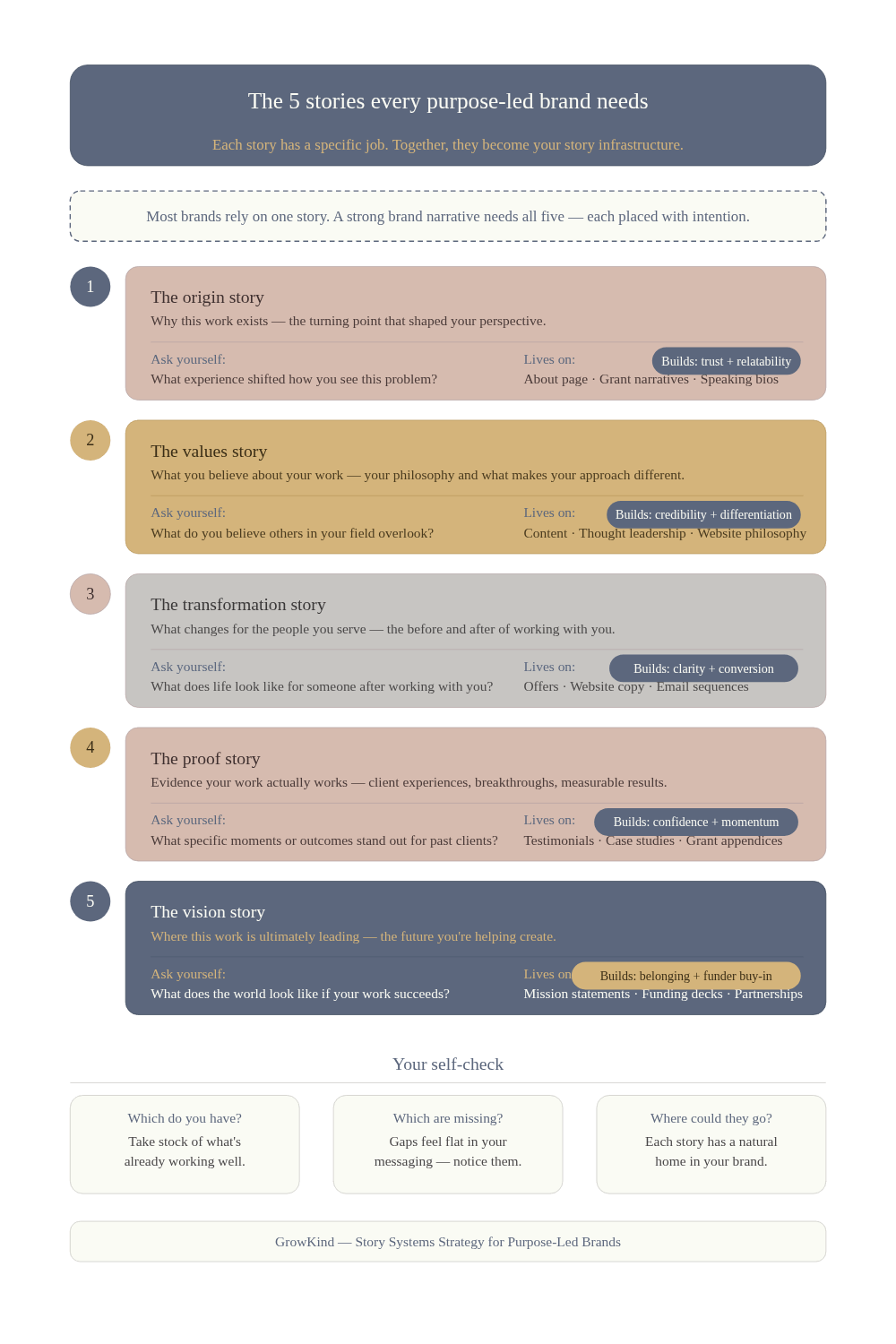
Here are the five stories every purpose-led brand needs.
The Five Stories Your Brand Needs
Story 1: The Origin Story
Like the name suggests, your origin story answers the question how you came to do the work you do.
In telling this part of your story, you don’t want to list off a timeline like your resume, but the point that captures your turning point. What was the moment that changed how you see the problem you now solve?
The origin story builds trust and emotional context and helps your audience understand not just what you do, but why it matters to you specifically. Remember this is a time when the market is crowded with people who carry your credentials, so your origin story may be the piece that strikes connection and relatability with your right-fit client giving them an immediate sense that you understand the struggles they are going through and are the exact person they need to guide them through to the next step.
Ask yourself:
What experience shifted how you see this problem?
What gap did you witness firsthand that others were missing?
Was there a personal experience that gave you an understanding most people in your field don’t have?
What made you realize this work was yours to do?
Your origin story lives most naturally on your About page and in any introduction where someone is meeting you for the first time. But it also shows up in grant narratives, pitch decks, and anywhere someone needs to understand the “why” behind your work before they can trust the “what.”
Story 2: The Values Story
The values story answers a different question: how do you approach this work and why does that approach matter?
This is the story of your philosophy, your beliefs, and the things you refuse to compromise on, and the principles that shape every decision you make.
Most founders skip this one because they assume their values come through in everything else they do. But when your values aren’t named explicitly, your audience has to guess at them. Sometimes, people who are deciding whether to hire you, fund you, or refer you don’t want to guess.
A values story establishes thought leadership. It differentiates you not just by what you do, but by how you think. And for purpose-driven leaders especially, it signals alignment which is often what converts a reader into a client.
Ask yourself:
What do you believe about your field that others tend to overlook?
What have you seen done badly, and what does doing it well actually look like?
What do you refuse to do, even when it would be easier?
Your values story shows up in the content you create and in your thought leadership. The posts, articles, and conversations where you share your perspective on the work all convey what you believe and how you show up in the world. It’s also essential in any space where someone is deciding if you’re the right fit.
Story 3: The Transformation Story
While all of these stories are important, the transformation story is probably one of the most important for your clients because it tells them: what will actually be different if I work with you?
This story moves through a before and an after showing them what their situation or experience looks like before your work and what becomes possible afterward.
This is not the same as a testimonial, though testimonials can carry pieces of it. The transformation story is about helping your audience see themselves in a clear, honest arc of change. It makes the outcome of your work visible and real.
For purpose-led founders, this story is often the hardest one to tell because they’re not used to claiming it. Saying “here is what changes” can feel like overpromising. But being vague or minimizing the work you are capable of doesn’t help to serve you or your potential clients.
Ask yourself:
What does life or work look like for someone before they come to you?
What does it look like after?
What’s the shift? Not just in outcome, but in how they feel, how they operate and in what becomes possible for them?
Your transformation story is the engine of your marketing. It belongs in your offers, your website copy, your email sequences, and anywhere you’re helping someone decide whether your work is the right next step for them.
Story 4: The Proof Story
In marketing we are taught we first make an emotional connection to a product, then use our logic to justify the purchase. Sales pages are specifically designed built on this psychology. Proof stories are needed for this same reason: they answer the question that logic asks after emotion has already opened the door.
Proof stories want to know if something really works. They include client experiences, case studies, specific moments of breakthrough, and measurable results. They don’t have to be dramatic. They just have to be real, specific, and honest.
Many purpose-led founders are uncomfortable with this one because sharing results can feel like bragging. Highlighting client wins can feel like using someone’s experience for your benefit. But proof stories, told with care, give your potential clients permission to believe that change is possible for them too.
Ask yourself:
What has shifted for the people you’ve worked with?
What specific moments or outcomes stand out?
What would a past client say about what changed?
Proof stories live in testimonials, case studies, and proposal appendices. They’re also powerful in grant applications, where funders need to see evidence of impact before they’re willing to invest.
Story 5: The Vision Story
The vision story answers the biggest question of all: where is this work ultimately going?
This story lifts your brand out of the day-to-day and places it inside a larger purpose. It’s not about what you did last quarter or which clients you’re currently serving. It’s about the future you’re helping to create and why that future is worth working toward. And sometimes dreaming big is the funnest part!
For nonprofit leaders, educators, and purpose-led founders, this story is often the one closest to their heart as well as the one they share the least strategically. They speak about it passionately in conversation, but forget to put it on the page in a way that connects to their audience’s own hopes.
The vision story creates belonging. It invites people to be part of something bigger than a transaction. For funders and partners especially, it’s often the story that turns interest into commitment.
Ask yourself:
What does the world look like if your work succeeds?
What problem becomes smaller, less common, or more solvable because you exist?
What are you building toward — not just for your clients, but for your community or field?
Your vision story belongs in your mission statements, your funding proposals, your partnership conversations, and anywhere you’re inviting someone to invest in your work. not just buy it.
Why Most Brands Only Use One Story
I’ve noticed most founders discover the power of storytelling, starts sharing their origin story and then repeat it everywhere. They share it in their About page, their Instagram bio, their grant narrative, their pitch deck, their email introduction.
All of it circles back to the same story of how they got here.
And the origin story is important. But when it’s the only story a brand tells, the message starts to feel incomplete. Audiences feel connected to the founder, but unclear on what to do next. Funders understand the passion but can’t find the proof. Potential clients feel the mission but can’t picture the transformation.
Each of the five stories answers a different question. When one is missing, there’s a gap that your audience feels it, even if they can’t name it.
When all five stories are present and placed intentionally, your messaging becomes more than the sum of its parts. It becomes a system that works everywhere: on your website, in your proposals, in your content, and in every conversation where you need your brand to do its job without you having to start from scratch.
Where These Stories Actually Live in Your Brand
This is where story becomes infrastructure. Each of the five stories has a place in your brand where it does its best work.
Origin story → Your About page, grant narrative introductions, speaking bios
Values story → Thought leadership content, website philosophy sections, team culture documents
Transformation story → Offer pages, marketing copy, email sequences, intake materials
Proof story → Testimonials, case studies, grant appendices, partnership proposals
Vision story → Mission statements, funding decks, partnership conversations, annual reports
When you know which story belongs where, content creation stops feeling like guessing. You’re not starting from zero every time but instead pulling from a clear, organized narrative system that already knows its purpose.
This is also what makes your messaging consistent across platforms and team members. When the stories are mapped, anyone on your team can draw from them.
Ready to Map Your Five Stories?
Inside my consulting work, we build out each of these five stories intentionally — not just as standalone pieces of writing, but as a connected narrative system that supports your website, your grant language, your content, and your team communication.
We start by identifying which stories are already strong, which ones are vague, and which ones are missing entirely. Then we build them out in a way that sounds like you — clear, specific, and aligned with how you actually want to grow.
If you’re not sure which of your five stories has the biggest gap, the Story Gap Audit is a focused place to begin. It gives you a clear picture of where your narrative is working and where it needs support so you can stop guessing and start building.
Because a great brand isn’t built on one story told well.
It’s built on the right stories, told with intention, placed where they can do their best work.
Let us know what you think in the comments!
YOU MIGHT ALSO LIKE

laura
About Laura DaGrossa, MEd
Helping purpose-led professionals reconnect with the story behind their practice, define their philosophy of care, and turn it into communication systems that attract the right clients and supporters.



Inspiration in your Inbox!
Sign up to learn how story shapes perception, how systems shape sustainability, and how to build real impact without performance or burnout.

free signup
© 2026 GrowKind Creative All Rights Reserved
Home | Terms & Conditions | Privacy