The Difference Between Emotional Storytelling and Strategic Storytelling
You’ve been told to, “Just tell your story.”
You’ve heard it a hundred times.
And so you do. You open your heart and share a vulnerable post about why you started this work explaining in detail about the hard moment that shaped your purpose. You share what drives you, what you’ve been through, and what you care about.
The comments are filled with people saying how beautiful it is, how moved they are, and how people like you are needed in the field.
And while of course that’s wonderful to hear, what you’d really like is for the right-fit clients
to reach out, for the grant committee to understand the totality of your impact, and for your team to be able to explain what you do when you’re not in the room.
Emotional storytelling is real, it matters, and it has a place in your brand.
But emotional storytelling alone is not a strategy.
There is a second kind of storytelling that most purpose-led founders have never been taught. It’s called strategic storytelling. The difference between the two is exactly where most mission-driven brands get stuck.
What Is Emotional Storytelling?
Emotional storytelling is what most people mean when they say “tell your story.” It focuses on personal experience, vulnerability, and human connection. It invites your audience to feel something.
It looks like:
Sharing the moment you realized you wanted to do this work
Describing a personal struggle that shaped your perspective
Highlighting a client transformation that moved you deeply
Opening up about the “why” behind your mission
Emotional storytelling is powerful because it creates warmth and humanizes your brand. With all of today’s AI-generated, transactional marketing, emotional storytelling can be genuinely refreshing.
| Emotional storytelling creates connection. But connection alone does not create clarity.
It’s clarity, not just connection, that moves people to trust you, hire you, fund you, or refer you.
When story stops at emotion, something gets left behind. The reader feels something, but they don’t know what to do with that feeling. They’re moved, but not guided. Inspired, but not sure where to go next.
That’s the gap emotional storytelling alone can’t close.
What Is Strategic Storytelling?
Strategic storytelling is when story is used with intention. Your goal is not just to create connection, but to clarify, position, and guide.
It goes a step further than emotional storytelling because it’s about being more purposeful with the stories you choose to tell, when you tell them, and what you want people to understand afterward.
Strategic storytelling does several things that emotional storytelling doesn’t do on its own:
It clarifies your positioning by stating who you help, how, and why it matters
It reinforces your expertise through showing, not just telling, that you understand this problem deeply
It communicates transformation by making the outcome of your work visible and concrete
It guides decision-making in giving your audience a clear next step
It supports visibility and funding by speaking a language that clients, partners, and grant makers can actually act on
Strategic storytelling answers questions your audience is quietly asking, even if they never say them out loud:
Why does this work matter?
Why this approach, and not another?
Why now?
Why you specifically?
When those questions get answered through story, something shifts. Your audience not only feels connected to you, but they trust you and they know what you are asking them to do next.
| In strategic storytelling, story becomes structure, not just expression.
What Happens When Emotion Isn’t Paired With Strategy
In my experience, purpose-led founders with their own small to medium sized businesses lose momentum because they know the work they are doing is meaningful, but they become burnt out when others fail to see the value in their uniqueness.
Here’s what it often looks like in practice:
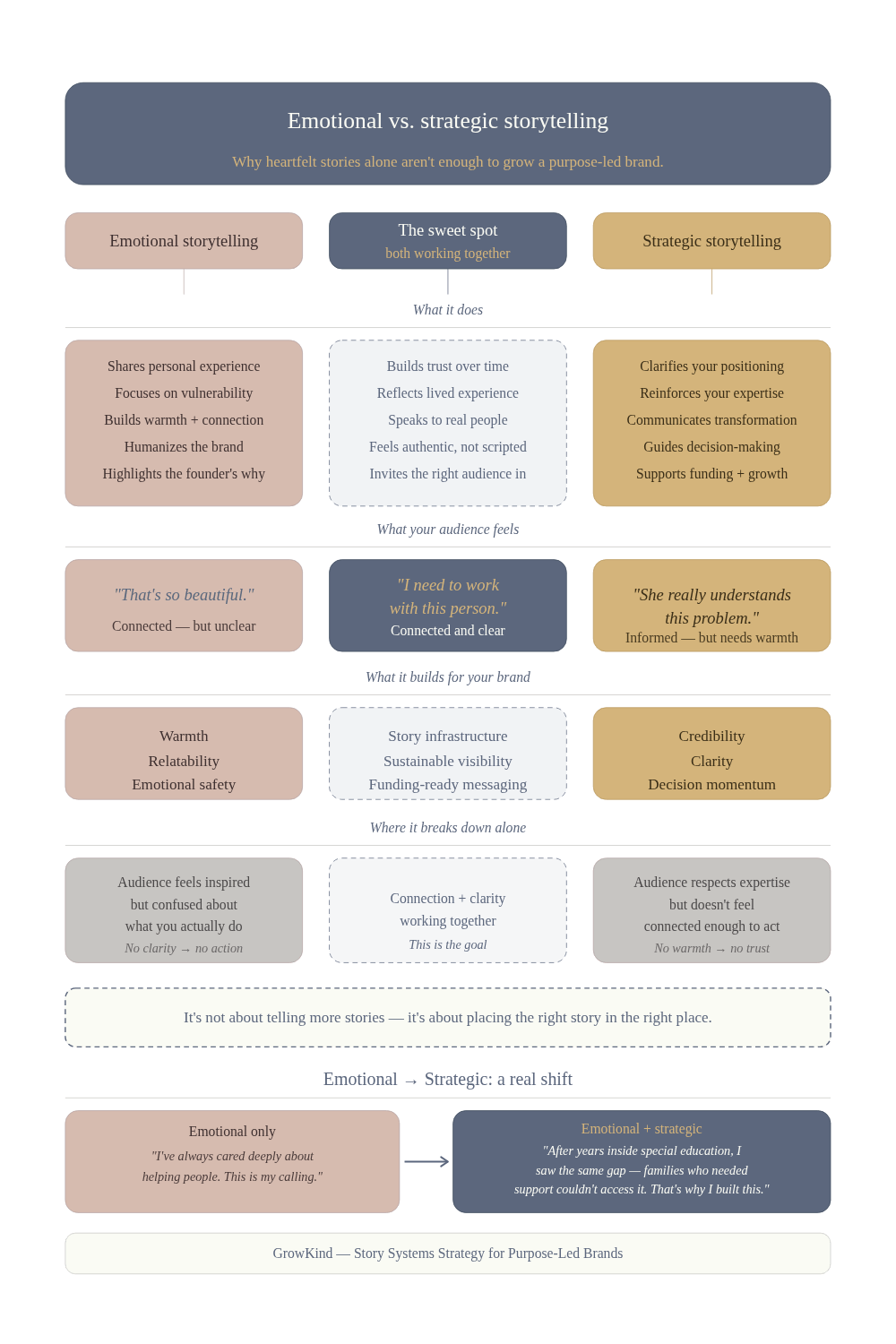
The audience feels inspired… but confused about what you do.
They read your post or your about page and feel genuinely moved. But when a friend asks, “what does she actually do?” they can’t quite explain it. The emotion landed, but the messaging didn’t.
The story is moving… but doesn’t guide action.
There’s no clear next step. After the reader finishes the post, they know they feel emotion, but they continue to scroll on. The story created a moment, but not a movement.
The founder shares vulnerability… but never establishes authority.
This one is subtle, and it matters especially for educators, therapists, and nonprofit leaders. When you lead entirely with personal struggle or emotional experience without weaving in your expertise, your audience may feel for you, but not yet feel confident hiring you.
The result is an audience that thinks:
“That’s so beautiful.”
When what you need them to think is:
“I need to work with this person.”
Both responses come from story. But only one of them moves your brand forward.
The difference isn’t the depth of your story. It’s whether your story is doing strategic work alongside the emotional work.
What Strategic Storytelling Actually Does for Your Brand
When emotional and strategic storytelling work together, your brand starts to function differently. Here’s what becomes possible:
Complex work becomes understandable.
Many purpose-led founders do work that’s genuinely hard to explain. It’s layered, nuanced, and often deeply personal. Strategic storytelling gives that complexity a narrative arc people can follow and remember.
You become the guide, not just the narrator.
There’s a difference between sharing your story and using your story to lead people somewhere. Strategic storytelling positions you as a guide with lived experience and a clear framework instead of just someone who has been through something hard.
The transformation you provide becomes visible.
Your audience needs to see not just who you are, but what life looks like for people after they work with you. Strategic storytelling makes that transformation concrete and specific, which is exactly what both clients and funders are looking for.
Trust deepens into credibility.
Grant reviewers read hundreds of applications. They are looking for clarity, not poetry. When your mission is specific and your outcomes are concrete, your application rises to the top, not because it's louder, but because it's clearer. Remember the funders are people, and they are moved by emotion. So being clear and specific about what you do and telling your story about your why just could mean the difference in receiving meaningful funding.
You stop over-explaining.
Emotional storytelling builds trust. Strategic storytelling builds credibility. You need both. Trust says, “I like this person.” Credibility says, “This person knows what they’re doing.” Together, they say, “I’m ready to move forward.”
Funding and partnership conversations get easier.
Grant reviewers and potential partners aren’t just moved by mission; they need to understand impact, approach, and outcomes. Strategic storytelling translates your heart-led work into language that a funding committee can evaluate and support.
It’s not about telling more stories. It’s about placing the right story in the right place for the right reason.
This is what I mean when I talk about story infrastructure. When your stories are placed with intention whether it’s on your website, in your grant language, in your onboarding materials, or in your social presence, they stop being scattered moments of connection and start being a system that works for you every time.
What This Looks Like in Practice
Let’s make this concrete with a simple side-by-side example.
Here’s an emotional story:
“I started this work because I’ve always cared deeply about helping people. Seeing others struggle has never sat right with me. This work is my calling.”
Here’s a strategic story:
“After years of working inside the special education system, I kept seeing the same gap: families who needed early intervention services couldn’t access them. Of course the services existed, but no one was available to help newly diagnosed families navigate the language or the system. That gap is what led me to build a practice focused entirely on helping families go from overwhelmed and unheard to informed and empowered, usually within the first 90 days when early intervention is the most impactful.”
Both stories come from a real person who genuinely cares. But notice what the second one does differently:
It provides context (where this person has been and what they’ve seen)
It names a specific problem (not just that people struggle, but how and why)
It clarifies the approach (what this founder built and for whom)
It makes the transformation concrete (overwhelmed and unheard to informed and empowered)
It gives a timeframe (which adds credibility and specificity)
The emotional story creates warmth. The strategic story creates trust, clarity, and a reason to reach out.
You don’t have to choose between the two; the goal is to have both working together.
A Few Questions to Sit With
Before you move on, take a moment to reflect on the stories you’re currently telling in your brand. Ask yourself:
What story explains why your work matters. You aren’t answering this for only yourself, but also for the people you serve?
What story shows how you developed your approach? What have you seen or lived that shaped the way you work?
What story helps people understand the transformation you provide? What does life look like for someone after they’ve worked with you?
If your stories tend to inspire people but leave them a little unclear about what you actually do, that’s a signal. It doesn’t mean your stories aren’t meaningful. It means they may be doing emotional work without yet doing strategic work.
That’s not a flaw, but an invitation to go deeper.
Ready to Move from Story to Strategy?
Inside my consulting work, I help purpose-led founders move beyond emotional storytelling and build strategic narrative systems and story frameworks that support visibility, referrals, and funding without losing the heart that makes their work matter.
We look at where your current stories are landing, where they’re missing structure, and how to build the kind of story infrastructure that works across your website, your grant language, your team communication, and your content.
If you’re unsure where your story lacks structure, the Story Gap Audit is often the first place we begin. It’s a focused assessment designed to show you exactly where the gaps are and what to do about them.
Because the goal was never just to tell a great story.
The goal is to build a brand that people understand, trust, and choose.
Let us know what you think in the comments!
YOU MIGHT ALSO LIKE

laura
About Laura DaGrossa, MEd
Helping purpose-led professionals reconnect with the story behind their practice, define their philosophy of care, and turn it into communication systems that attract the right clients and supporters.




Inspiration in your Inbox!
Sign up to learn how story shapes perception, how systems shape sustainability, and how to build real impact without performance or burnout.

free signup
© 2026 GrowKind Creative All Rights Reserved
Home | Terms & Conditions | Privacy