What I Look For First in a Brand Audit (And It's Not What Most People Expect)
If you've ever Googled "brand audit," you've probably come away with a checklist that looks something like this: review your logo and visual identity, audit your social media consistency, analyze your website traffic, check your content calendar, assess your SEO.
And those things matter. Eventually.
But when I sit down with a new client for a brand audit, none of that is where I start.
I start with the story. More specifically, I start looking for where the story breaks.
Because in almost every case I've encountered, the visibility problem, the funding problem, the "why aren't the right people finding me" problem, isn't a design problem or a traffic problem. It's a clarity problem. And clarity problems have a very specific origin.
They start with a gap between what someone knows about their own work and what they're actually communicating to the people who need it most.
That gap has a name. I call it the story gap. And finding it is always the first thing I do.
What Most Brand Audits Get Wrong
Traditional brand audits are built around performance. They ask: what's working, what isn't, and how do we optimize? That's a reasonable framework if your foundation is solid.
But for most of the founders, therapists, and nonprofit leaders I work with, the foundation is the problem. No amount of optimizing will fix a message that isn't yet clear.
Think of it this way: If you have a leak in your house, repainting the walls doesn't solve it. It just makes the damage look better for a little while.
A story gap works the same way. You can post more consistently, run better ads, redesign your website, and still find that the right people aren't connecting with what you do.
That's because the root issue was never execution. It was the message itself.
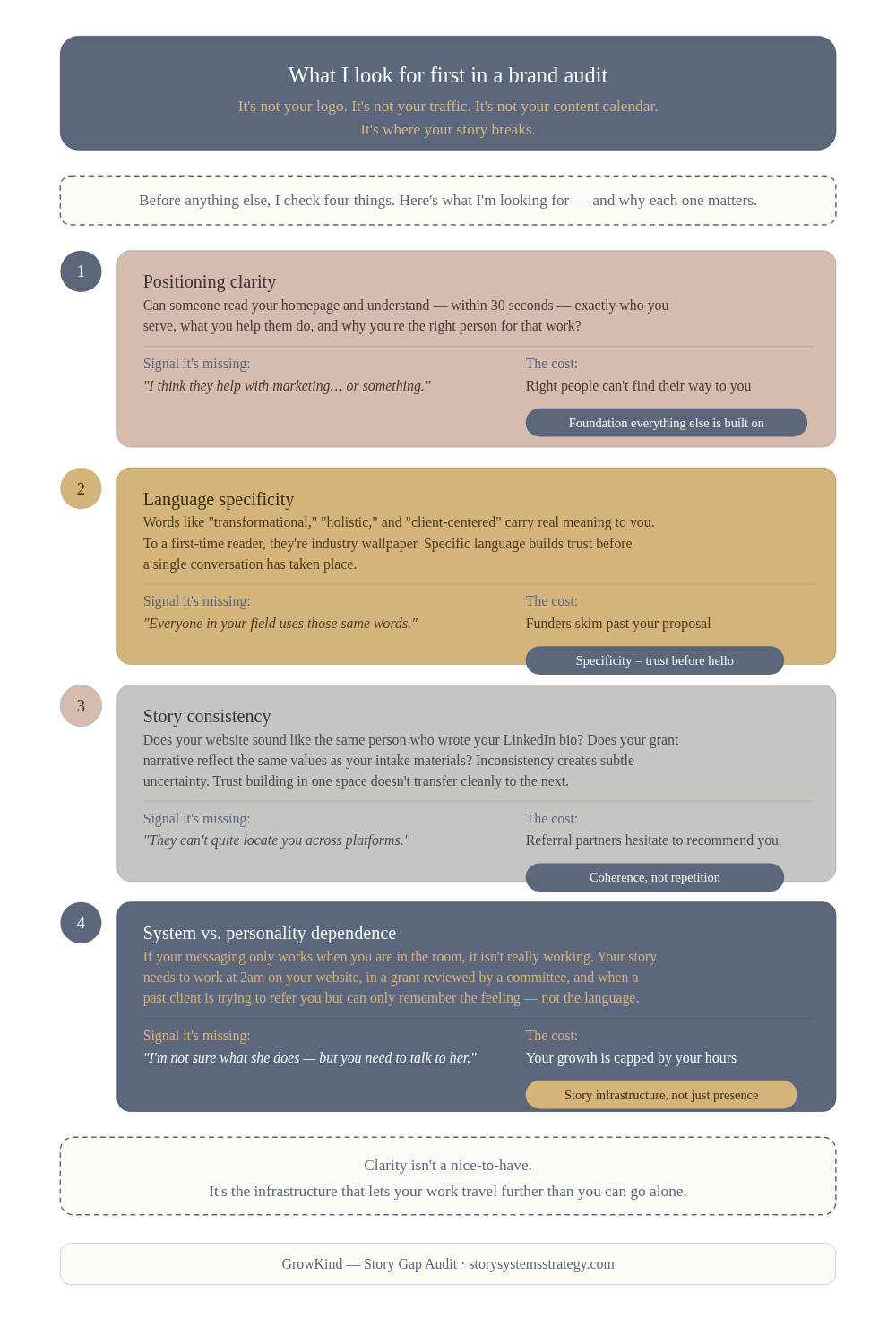
So before I look at anything else, I look at four things.
The Four Things I Check First
1. Positioning clarity
The first question I ask is deceptively simple: can someone who doesn't already know you read your homepage and understand, within thirty seconds, exactly who you serve, what you help them do, and why you're the right person for that work?
Not a general sense of it. Not "I think they help with marketing or something." Specifically and unmistakably.
When positioning isn't clear, it usually isn't because the person hasn't thought hard enough about their work. It's because they're so close to it that they've started describing it from the inside out rather than the outside in. They're writing for people who already understand the context rather than for people who are encountering it for the first time.
Positioning clarity is the foundation everything else is built on. If it isn't there, nothing downstream will perform the way it should.
2. Language specificity
Generic language is one of the most common and most costly messaging problems I see. And it's almost never intentional.
When you're deeply embedded in your field, certain words start to feel like shorthand for something much larger and more nuanced: Trauma-informed. Holistic. Evidence-based. Client-centered. Transformational.
These words carry real meaning for the people using them. But to the person reading your website or your grant proposal or your Instagram bio for the first time, they read as industry wallpaper. They blend into the background because everyone in your field is using the same words.
Specific language does something different. It shows your reader that you've thought carefully about them, about what they're actually carrying, about what they're hoping for, and about what makes your approach distinct from the next qualified person in your field.
Specificity builds trust before a single conversation has taken place.
3. Story consistency
The third thing I look for is whether the story holds across touchpoints. Does your website sound like the same person who wrote your LinkedIn bio? Does your grant narrative reflect the same values and language as your intake materials? Does your email list feel like a natural continuation of your social presence?
When the answer is no, and it often isn't, it creates a subtle but powerful problem. People who encounter you in one place and then find you in another start to feel uncertain. They can't quite locate you.
The trust that was building in one space doesn't transfer cleanly to the next. And trust, especially for mission-driven work, is everything.
Story consistency isn't about being repetitive. It's about being coherent. It's about having a clear enough sense of your own narrative that it naturally shows up, recognizably, wherever you are.
4. System versus personality dependence
This is the one that surprises people most. And it's the one I've come to think of as the clearest indicator of whether someone's messaging is actually working or just appearing to work.
Here's what I mean: If your messaging only works when you are in the room, it isn't really working.
You know this is happening when you hear things like: "I'm not sure what I just heard, but it sounds amazing." Or when a potential client calls your office and your staff has to tell them they'll need to speak with you directly because no one else can quite explain your process. Or when referrals come in saying "a friend told me about you, but honestly I'm not sure what you do, she just said I needed to talk to you."
These responses feel like compliments. And in some ways, they are. But they're also signs that your message lives inside your personality and your presence rather than inside a system that can travel without you.
That matters because your message needs to be working when you're not in the room. It needs to work on your website at two in the morning when someone is searching for exactly what you do. It needs to work in a grant application being reviewed by a committee who has never met you. It needs to work when a past client is trying to refer you to a friend and can only remember the feeling of what you did, not the language.
When your story is only compelling because you're there to tell it, you have a story infrastructure problem. And that's the problem I'm built to solve.
Why This Matters Beyond Marketing
I want to be clear that I'm not talking about messaging as a marketing exercise. I'm talking about it as a survival strategy for mission-driven work.
When your positioning is unclear, potential clients can't find their way to you. They choose someone else, not because that someone else does better work, but because their message is easier to understand.
Generic language causes funders to skim past your proposal. Not because your program isn't strong, but because it reads like every other proposal in the stack.
Referral partners hesitate to mention you to others when you have an inconsistent story. They want to send people your way, but they don't feel confident enough in their ability to explain what you do to make the recommendation.
When your message depends on your presence, your growth is capped. Your impact is limited by your hours. Your reach extends only as far as you can personally carry it.
Clarity isn't a nice-to-have. It's the infrastructure that lets your work travel further than you can go alone.
Where the Audit Comes In
A Story Gap Audit is exactly what it sounds like: a structured, personalized review of where your message is losing clarity, cohesion, or power, and what to do about it.
It's not a checklist. It's not a generic report with color-coded scores. It's a deep look at the four areas I described above, specific to your work, your voice, and the people you're trying to reach, followed by a 45 to 60 minute personalized video walkthrough of exactly what I found and how to address it.
Most of my clients start here. It's designed to give you real, actionable strategic insight whether we work together further or not. And for many people, it's the first time someone has looked at their messaging and actually seen what's happening underneath.
If any of what I described above sounds familiar, the audit is the right next step.
Let us know what you think in the comments!
YOU MIGHT ALSO LIKE

laura
About Laura DaGrossa, MEd
Helping purpose-led professionals reconnect with the story behind their practice, define their philosophy of care, and turn it into communication systems that attract the right clients and supporters.



Inspiration in your Inbox!
Sign up to learn how story shapes perception, how systems shape sustainability, and how to build real impact without performance or burnout.

free signup
© 2026 GrowKind Creative All Rights Reserved
Home | Terms & Conditions | Privacy