Why Brand Specificity Is More Important Than Content When It Comes To Visibility
You've heard yourself say it. Maybe you've said it out loud to a colleague or whispered it after staring at your analytics for the third time this week.
"I just need to be more visible."
Client acquisition was one of the top concerns my clients shared with me when I asked them how I could help.
Their solution was doing more: Writing more posts. Making more reels. Maybe signing up for yet another webinar about content strategy.
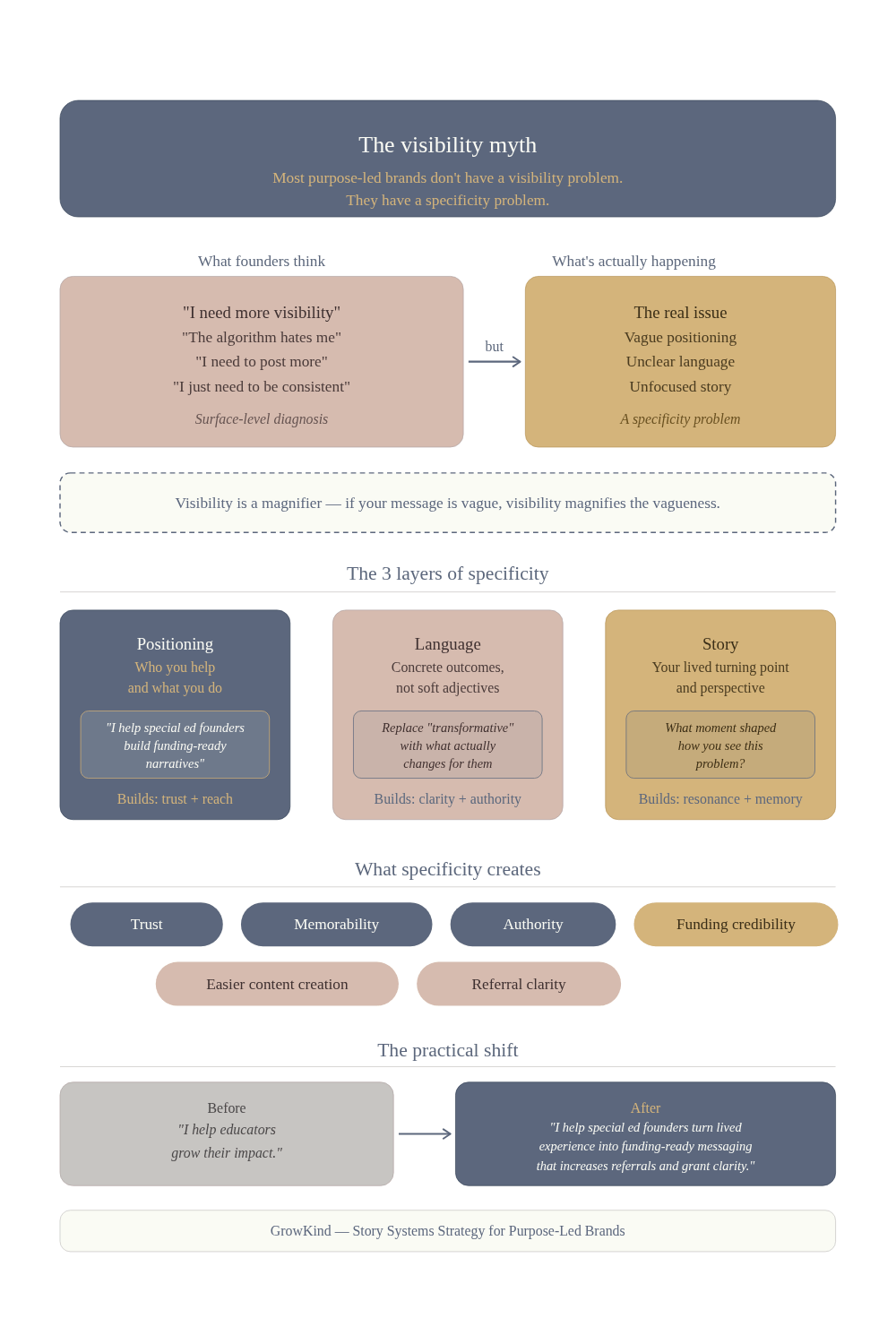
In my experience, most purpose-led brands don't have a visibility problem.
They have a specificity problem.
If your message is vague or isn’t landing right in the first place, getting more eyes on it just magnifies the vagueness and inaccuracy. So what you need isn’t more reach, but more precision, or brand specificity.
What Is Brand Specificity, And Why Does It Matter?
Specificity is not the same as being narrow. It doesn't mean you have to shrink your work or leave people out. It means you are clear enough that the right people immediately recognize themselves in what you say.
There are three layers where specificity lives in your brand. Most people only fix one — and wonder why it still doesn't feel right.
Specificity in Positioning
This is how you describe who you help and what you do for them. Most purpose-led founders default to something like:
"I help women feel empowered."
While that sounds meaningful, it’s also very broad and generic. There are thousands of people who could say that sentence. It doesn't tell anyone why you, why now, or why it matters for them specifically.
Meredith Hill is credited for saying, “When you speak to everyone, you speak to no one.” And, in a business sense, it means when your brand positioning is so open, it becomes invisible. Seth Godin paraphrased Ms. Hill’s words by explaining, “Everyone is not your customer.” And it’s true; not everyone is.
Compare it to something like:
"I help special education founders build funding-ready narratives so they can attract aligned clients and secure grant support without losing the heart of their work."
Now someone reads that and thinks: That's me. She's talking to me.
That's what specificity in positioning does. It narrows the noise so the signal comes through.
Specificity in Language
Look at your website right now. Count the words like these: transformative, impactful, holistic, passionate, innovative, empowering, authentic.
Now ask yourself: what do those words actually mean in the context of your work?
Most of the time, they mean something real to you, but very often, they mean nothing concrete to the person reading. Adjectives like these create the feeling of meaning without the substance of it.
Specificity in language means trading soft descriptors for concrete outcomes. Instead of:
"Our transformative approach empowers educators to find their voice."
Try:
"We help educators go from unclear and overwhelmed to a brand message they can actually use whether it’s in their proposals, on their website, or in the room."
The second version is not flashier, it's just truer. And truth is what builds trust with your clients.
Specificity in Story
This is the layer most people skip entirely (but it also happens to be my favorite!)
They share that they "care deeply about their community" or that they've "always been passionate about education." Of course those things may be completely true, but they don't create resonance.
Specificity in story means naming a real moment, a real tension, or a real turning point.
What happened that made this work feel necessary?
What did you understand that most people in your field still don't see?
What have you survived, built, or witnessed that shaped your perspective?
That's where your authority lives. It’s not something found within your credentials hanging on the wall. It comes from your lived experience.
When your brand has specificity across all three layers: positioning, language, and story, then something shifts.
You start to create:
Trust, because people see themselves in your words
Memorability, because specific ideas stick where vague ones slide off
Authority, because your voice sounds like someone who has actually lived this
Funding credibility, because grant reviewers and funders can understand your impact in plain language
Why Purpose-Led Brands Struggle to Be Specific
So, if specificity is so powerful, why don't more purpose-driven brands have it?
It's not because the leaders aren’t smart or aren’t passionate enough. I’ve found it’s usually a result of one or more of these things is true:
They're multi-passionate.
Their work genuinely touches many areas: education, healing, community, policy, art. They worry that naming one thing means abandoning the rest. So they try to hold everything at once, and the message collapses under its own weight.
They've been shaped by institutional language.
Educators, therapists, advocates, and nonprofit leaders often come from environments where writing means reports, grant templates, or academic language. That formal, safe, distant style becomes a habit. It's professional-sounding, yes. But it's also connection-resistant. (I know, I worked in this industry for my career.)
They're afraid of excluding people.
There's a deep generosity in mission-driven work, and these leaders genuinely want to help as many people as possible. They believe that in making their message more specific, it feels like they are closing a door to others who also need them. In reality, it opens the right ones.
They don't know what makes them different.
We are usually so close to our own work to see our own uniqueness and our own gifts clearly. It takes outside eyes to reflect back what's so powerful about what they do.
Underneath all of it is a belief that has been running the show:
“If I try to appeal to everyone, I won’t leave anyone out.”
But remember: when you speak to everyone, you speak to no one. Vague messaging doesn't protect you from rejection. It just delays the connection you're hoping for.

What Changes When You Fix the Specificity Problem
When your messaging is specific, something almost counterintuitive happens: instead of reaching fewer people, you reach the right people, and they respond differently.
The right clients feel seen.
They read your website or your proposal and think, ‘finally! Here’s someone who gets it.’ In my experience, the clients you are often working with can spot inauthenticity a mile away. They can tell those who learned from lived experience and those who learned from a textbook, so don’t be afraid to show your real self in your marketing collateral. That feeling of being truly seen is what moves people from interest to trust. And trust is what converts.
Referrals become more natural.
When your message is clear, the people in your network know exactly who to send your way. Vague messaging creates vague referrals. Specific messaging creates perfect-fit introductions.
Funders understand your impact.
Grant reviewers read hundreds of applications. They are looking for clarity, not poetry. When your mission is specific and your outcomes are concrete, your application rises to the top, not because it's louder, but because it's clearer. Remember the funders are people, and they are moved by emotion. So being clear and specific about what you do and telling your story about your why just could mean the difference in receiving meaningful funding.
You stop over-explaining.
One of the biggest frustrations of vague messaging is that you end up compensating in conversations. You add context, rephrase, back up, try again. When your message is specific, you just say it, and people get it the first time.
Your content becomes easier to create.
This one surprises people. But it makes sense: when you know exactly what you stand for, who you're talking to, and what you want them to feel, content becomes a natural extension of that clarity. You stop starting from scratch and start pulling from a clear well.
This is what I mean when I talk about story as infrastructure.
Specificity isn't a branding tweak you do once and forget. It's a structural decision. When your story is specific at every layer: positioning, language, and lived experience, it becomes the foundation that everything else is built on.
You stop rebuilding from zero every time. You start building on something solid.
A Practical Mini-Shift You Can Try Right Now
You don't need to overhaul everything today, but here's a small shift that can start to move things.
Look at how you currently describe your work. It might sound something like:
"I help educators grow their impact."
Now, try rewriting it by adding three layers of specificity:
Who, exactly, are you helping? (Be as specific as you can.)
What do you actually help them do? State it in plain, jargon-free language (as a guideline, most websites should be written at a 7th or 8th grade level or lower.)
What does their life or work look like after they work with you?
Here's what that could sound like with those layers added:
"I help special education founders turn their lived experience into funding-ready messaging that increases referrals and grant clarity so they can stop over-explaining and start being chosen."
If you're not sure where to start, try sitting with these three reflection questions:
What do I actually help people do? Again, state it in plain, everyday language.
What is the real transformation? What changes for them after we work together?
What moment or experience shaped why I do this work? What do I understand from the inside that others might miss?
Write your answers down. Don't edit them. Don't make them sound professional. Just let them be honest.
That honesty is where your specificity starts.
Not Sure Where Your Messaging Lacks Specificity?
That's exactly the question the Story Gap Audit is designed to answer.
It's a focused assessment that looks at your current brand messaging in your website, your language, your story, and identifies where the gaps are between what you mean to say and what people actually receive. You’ll receive a detailed video and PDF telling you exactly where to start!
Let us know what you think in the comments!
YOU MIGHT ALSO LIKE

laura
About Laura DaGrossa, MEd
Helping purpose-led professionals reconnect with the story behind their practice, define their philosophy of care, and turn it into communication systems that attract the right clients and supporters.



Inspiration in your Inbox!
Sign up to learn how story shapes perception, how systems shape sustainability, and how to build real impact without performance or burnout.

free signup
© 2026 GrowKind Creative All Rights Reserved
Home | Terms & Conditions | Privacy