Why Clearer Articulation Changes More Than Your Messaging
There's a moment most purpose-led founders know well.
Someone asks what you do, and what comes out is either too broad to mean anything, too technical to land quickly, or so loaded with context that you can see the other person's eyes start to drift before you've finished the first sentence.
So you try again by rephrasing, maybe adding an example, or backing up in order to come at it again from a different angle. And eventually, sometimes, it clicks. They get it. They say something like: "Oh, why didn't you just say that?"
And you think: I don't know. I genuinely don't know why I can't just say that.
What you’re experiencing is most likely an articulation gap. Understanding what that actually is — and what it isn't — may change how you think about your visibility, your authority, and your professional growth in ways that go well beyond messaging.
What an Articulation Gap Actually Is
It's easy to assume this is a messaging problem. A messaging problem suggests something is wrong with your message and that it needs to be rewritten, repositioned, or replaced with something better.
An articulation gap is different. Your message already exists. You likely already have real clarity and depth around your work. What's missing is the translation between what you know internally and the language that makes it legible to someone encountering your expertise for the first time.
You don't lack clarity. You lack translation.
That distinction matters more than it might seem. Because if you believe you have a messaging problem, you go looking for better words — a snappier tagline, a more polished bio. You rewrite the surface without touching the structure underneath. The problem persists because you were solving for the wrong thing.
If you understand that you have an articulation gap, you go looking for something different.
Why This Happens to the People Doing the Deepest Work
The articulation gap is most pronounced in people doing the most layered, most sophisticated, most genuinely complex work.
I used to visit a particular chiropractor. If you asked her what she does, she would say: "I'm a chiropractor." Which is true. But it doesn't begin to capture that her practice included myofascial release because she learned it loosens soft tissue and allows for more effective, longer-lasting adjustments and rehabilitation. That the adjustment itself is only one part of a layered approach to how the body holds tension and how it releases it. That the work she does is fundamentally different from the adjustment-and-out model most people associate with her title.
The title fits in a text field. The work doesn't.
I experience this in my own practice. When someone asks what I do, the honest answer involves strategic articulation, authority positioning, ecosystem coherence, AI-era differentiation, and the application of educational psychology to how experts process and communicate complex ideas. It's a framework built across years of work at the intersection of expertise, story, and human communication.
What comes out at a networking event is something far simpler since I call myself a 'thought leadership advisor' in my LinkedIn bio. It's technically accurate, and almost entirely insufficient.
The gap between those two things — between the depth of the work and the language available to describe it quickly — is exactly what I mean by an articulation gap. If you're reading this and feeling a flicker of recognition, you're likely living inside one too.
What It Looks Like From the Inside
Once you know what to look for, the articulation gap shows up in recognizable ways.
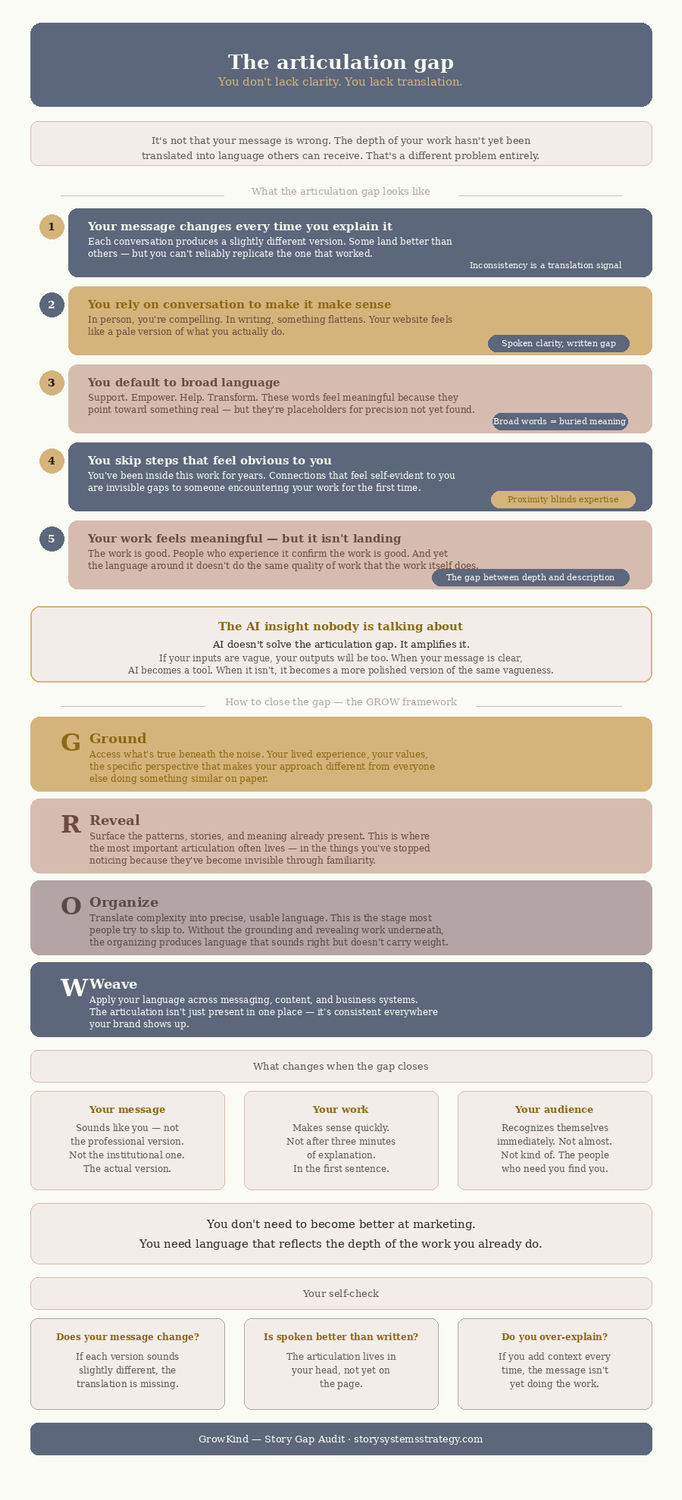
Your explanation changes depending on context. Each conversation produces a slightly different version. Some land better than others but you're not sure why, and you can't reliably replicate the one that worked.
Writing flattens what conversation carries. So in one-on-one conversations it's easier to be compelling, but In your website copy, something essential disappears. The written version feels like a pale representation of what you actually do.
You reach for broad language — words like support, empower, help, transform. These feel meaningful because they point toward something real. But they're placeholders for precision you haven't yet found. Your peers likely use them too which also takes away a lot of their meaning.
You skip steps that feel obvious to you. Because you've been inside this work for years, certain connections feel self-evident. But your audience doesn't have your context. What feels like a logical step to you is an invisible gap to them.
And perhaps most tellingly: the work is good. The people who experience it confirm it's good. And yet the language around it doesn't seem to do the same quality of work that the work itself does.
That last one is the articulation gap in its clearest form. A real mismatch between the depth of what you do and the language currently available to represent it.
Why It Matters More Than You Might Think
The articulation gap isn't just a communication inconvenience. It has real consequences for how your work moves through the world.
When your message isn't precisely articulated, potential clients almost understand. They're interested but uncertain. They can't quite tell if you're the right fit. They need multiple touchpoints, multiple conversations, multiple pieces of content before they feel confident enough to reach out. And some of them, the ones who would have been the most aligned, never do.
Referrals become imprecise. The people in your network want to send others your way but can't explain what you do with enough specificity to generate the right introductions. You get referrals that aren't quite the right fit.
Opportunities stall. Speaking invitations, partnerships, institutional recognition — these flow toward experts whose positioning communicates clear thought leadership. When articulation is unclear, even strong expertise gets passed over.
And visibility disconnects from traction. You can be seen by a lot of people and still not be found by the right ones. Being seen and being understood are not the same thing. Reach without articulation is just noise that reaches more ears.
The AI Insight Nobody Is Talking About
A lot of experienced professionals have turned to AI tools hoping they'll solve the articulation problem. I understand why. The promise is appealing: describe what you do, get back polished professional language instantly.
There’s a saying that if it sounds too good to be true, it probably is. Sure, AI can generate content quickly, but the reality is it cannot generate clarity you haven't yet found.
If your inputs are vague, your outputs will be too. If you tell an AI tool that you help people with their messaging and ask it to write your about page, it will produce something that sounds professional and means very little because the tool is working from the same articulation gap you brought to it.
AI doesn't solve the articulation gap; It amplifies it.
When your message is clear, AI becomes a genuinely powerful tool. It can take the language you've excavated and worked and sharpened and help you deploy it across formats, platforms, and contexts with remarkable efficiency.
But when the articulation isn't there yet, AI produces a more polished version of the same vagueness. Polished vagueness is actually harder to fix than rough vagueness, because it looks like it's working until you notice that nothing is converting.
The articulation has to come first. The tools come after.
The Shift: From Knowing to Articulating
Closing the articulation gap isn't about becoming better at marketing. It's about building the bridge between what you know and how you say it.
In my work, that bridge moves through four stages.
Ground — Getting precise about what's actually true beneath the noise. Your lived experience, your values, the specific perspective that makes your approach genuinely different from others doing similar work on paper.
Reveal — Surfacing the patterns, stories, and meaning already present in your work but not yet named or structured. This is often where the most important articulation lives — in the things you've stopped noticing because they've become invisible through familiarity.
Organize — Translating that complexity into precise, usable language. This is the stage most people try to skip to. But without the grounding and revealing work underneath it, the organizing produces language that sounds right but doesn't carry weight.
Weave — Applying that language across your messaging, your content, and your broader professional presence so the articulation isn't just present in one place but consistent everywhere your expertise shows up..
What Changes When the Gap Closes
When the articulation is finally in place, your message sounds like you. Not the professional version shaped by what your field expects. The actual version — the one that captures what you do and why you do it.
Your work makes sense quickly. Not after three minutes of explanation. Within the first sentence or two.
Your content becomes easier to create because you're pulling from a clear, organized foundation rather than rebuilding from scratch every time you sit down to write.
And your audience recognizes themselves in what you say. The people who need you most can find their way to you.
Referrals, speaking opportunities, partnerships, institutional recognition begin to align more naturally. Because the ecosystem surrounding your expertise is finally doing the work it was meant to do.
Where to Start
If you've been living inside this gap — rewriting the same bio, reworking the same positioning, explaining yourself in conversation and watching it fall flat in writing — the most useful first step is understanding exactly where the breakdown is happening.
The Articulation and Authority Scorecard is a diagnostic tool designed for exactly this moment. It helps experienced experts identify where their articulation gaps are creating the most friction and where to focus first.
You don't need to become better at marketing, just the language that finally reflects the depth of the work you already do.
Let us know what you think in the comments!
YOU MIGHT ALSO LIKE

laura
About Laura DaGrossa, MEd
Helping purpose-led professionals reconnect with the story behind their practice, define their philosophy of care, and turn it into communication systems that attract the right clients and supporters.




Inspiration in your Inbox!
Sign up to learn how story shapes perception, how systems shape sustainability, and how to build real impact without performance or burnout.

free signup
© 2026 GrowKind Creative All Rights Reserved
Home | Terms & Conditions | Privacy